
Why Linear Memory Changes the Cost of Image and Language Generation
Modern generative AI systems—large language models and image/video generators—are increasingly constrained not by raw compute, but by memory bandwidth and memory growth. As models scale to longer contexts and higher resolutions, the dominant cost driver becomes how much information must be stored, moved, and repeatedly reread during generation.
Cognade explores an alternative architectural approach—Phase as Integrator + Quad as Proposal—that changes these memory economics at a structural level.
This article explains what assumptions we make, what numbers we rely on, and where the real savings come from.
The Baseline Problem: Quadratic Memory in Attention
Most state-of-the-art generative models rely on attention mechanisms that require pairwise interactions between tokens or patches.
For a sequence or image with N elements and embedding dimension D:
- Key–Value (KV) memory grows as
O(N² × D) in the worst case - Even with windowing or optimizations, effective memory growth remains super-linear
In practice, this leads to:
- Rapid memory blow-up for long contexts or high resolutions
- Heavy dependence on HBM (High Bandwidth Memory) GPUs
- Multi-GPU inference for workloads that are conceptually sequential
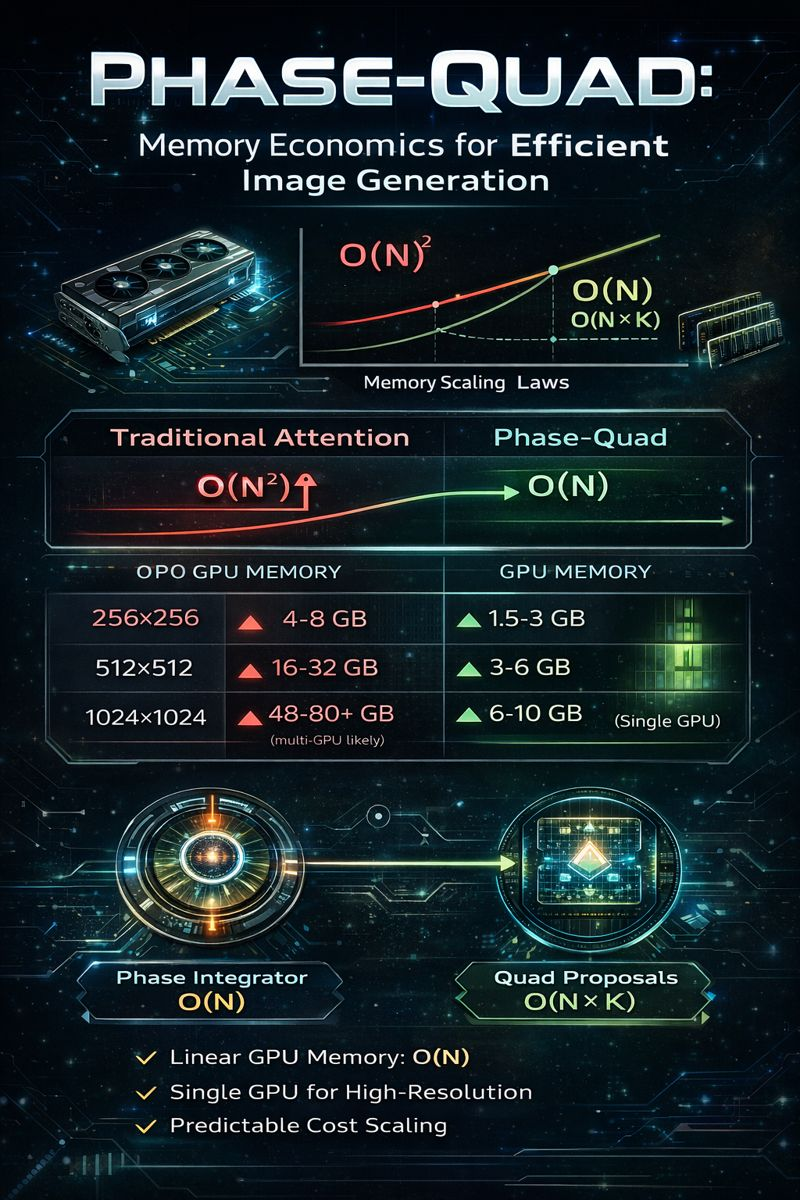
Concrete Example (Typical Ranges)
| Task | Approximate Memory Pressure |
|---|---|
| 256×256 image generation | ~4–8 GB |
| 512×512 image generation | ~16–32 GB |
| 1024×1024 image generation | >48 GB (often multi-GPU) |
These numbers vary by architecture and precision, but the scaling trend is consistent.
Cognade’s Assumption: Memory, Not Compute, Is the Bottleneck
Cognade starts from a conservative assumption:
For diffusion and long-context generation, wall-clock cost is dominated by memory movement—not FLOPs.
Supporting observations:
- Each denoising step rereads large portions of model weights
- KV caches dominate runtime memory
- Increasing GPU FLOPs without reducing memory traffic yields diminishing returns
This is where Phase–Quad intervenes.
Phase–Quad Architecture: A Different Scaling Law
Phase Integrator (O(N))
Instead of storing token-to-token relationships, Cognade uses phase accumulation:
- Each input contributes a bounded complex phasor
- Memory is accumulated via a linear scan (
cumsum) - No per-token identity or pairwise storage is retained
Memory growth:
O(N × D)
Quad Proposal (O(N × K), K ≪ N)
Instead of global attention:
- Queries retrieve Top-K proposals from phase memory
- No softmax mixing across all elements
- Proposals are sparse, explicit, and inspectable
Typical values:
K = 32–64- Independent of total resolution or context length
Memory growth:
O(N × K × D)
What This Changes in Practice
Revised Memory Profile (Defensible Ranges)
| Resolution | Traditional Attention | Phase–Quad |
|---|---|---|
| 256×256 | 4–8 GB | 1.5–3 GB |
| 512×512 | 16–32 GB | 3–6 GB |
| 1024×1024 | 48–80+ GB | 6–10 GB |
These are order-of-magnitude estimates, assuming FP16/FP8 and standard diffusion pipelines.
The key result is not the exact numbers—it is the linear scaling.
Role of HBM: Still Useful, No Longer Mandatory
Traditional Models
- HBM is required to prevent bandwidth starvation
- Scaling resolution almost always implies scaling GPUs
Phase–Quad Models
- HBM improves throughput, but is not structurally required
- High-resolution inference becomes feasible on:
- Single GPUs
- Lower-cost cloud instances
- On-prem or edge systems
Phase–Quad does not eliminate the value of HBM—it removes dependency on it.
SSD / NVMe: What It Helps (and What It Doesn’t)
Cognade does not assume SSDs replace GPU memory.
NVMe is used for:
- Fast checkpoint loading
- Model swapping
- Multi-model orchestration
NVMe does not accelerate inference, but Phase–Quad reduces the pressure to keep massive KV caches resident on GPU memory.
Honest Trade-offs and Limitations
Cognade does not claim free performance.
Known trade-offs:
- Sequential phase accumulation limits full parallelism
- Sparse proposal retrieval requires careful tuning
- New diagnostics are required to detect phase stagnation or jitter
- Training requires stability controls (e.g., gating temperature schedules)
These are architectural choices, not shortcuts.
Why This Matters for Enterprise and Frontier Models
Phase–Quad introduces a structural shift:
- Cost per token / pixel grows linearly
- Memory no longer dictates architecture viability
- High-resolution and long-context generation becomes economically predictable
For enterprises, this means:
- Lower inference cost
- Simpler deployment
- Fewer GPU dependencies
- More interpretable reasoning paths
What Cognade Is (and Is Not)
Cognade is:
- Focused on memory-first scaling laws
- Exploring alternatives to attention monoculture
Cognade is not:
- A replacement for all attention mechanisms
- A finished product
The goal is clarity—about how intelligence scales, and what it costs to run.
Closing Thought
Most AI progress today comes from adding more.
Cognade asks what happens when we store less, reuse more, and accumulate meaning instead of recomputing it.
That question alone is worth exploring.